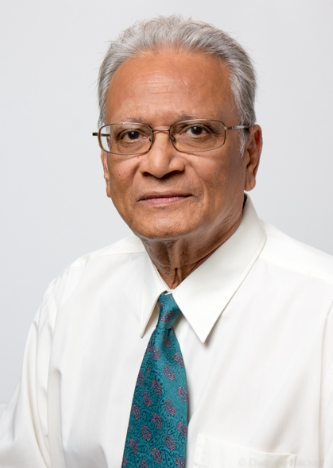
The University of Guyana to Stage Reading of Literary Works of Dr Rupert Roopnarine
Wednesday, March 4, 2026 - 13:08Dr Rupert Roopnarine
Dr Rupert Roopnarine (January 31, 1943 – February 23, 2026) will be universally celebrated as a man of thought and action, a man of the Renaissance, a man of academia and of the people, who could walk with kings but never lost the common touch. It is in memory of that intellectual quality that the University of Guyana celebrates his life and academic legacy.
Dr Rupert Roopnarine was a Senior Lecturer in the Department of English in the Faculty of Arts. He was a member of the University of Guyana’s Council prior to becoming Minister of Education which was his last substantial public role in Guyana. As an international intellectual he worked towards the betterment of humanity.
Dr. Roopnarine was a scholar, a statesman, a poet, a critic of the arts and of literature, a lecturer and film-maker who served the University as an expert on literature and philosophical thought, the nation as Minister of Education and Member of Parliament. He went from Queens College on a Guyana Scholarship to Cambridge where he read Comparative Literature and returned to Guyana after serving at Cornell University to join the University of Guyana in 1977. He combined scholarship with activism, driven by a proletarian philosophy that called for a deep knowledge of Marxism and modern political thought to the service of mankind.
Dr Roopnarine was fabled for oratorical eloquence as he articulated Continental and Romance Literature and Kafka in equal measure with Charles Dickens, Walt Whitman and the leftist teachings of Terry Eagleton. Yet he was a serious student of Martin Carter and of a Creole sensibility. The University marks his impact as a post-colonialist intellectual reminiscent of the Jacobin cry for “ liberte, egalite, fraternite ” when he struggled alongside Walter Rodney against totalitarianism in the 1970s.
Dr. Roopnarine reflects the Renaissance spirit in the balance of elements in his life as a scholar, a sportsman and an artist. He was a cricketer—a spin bowler for Queens College and afterwards for Cambridge University (1964 -1966), where he was awarded a Blue for his performance in sports.
He was a poet, publishing The Web of October: On Re-Reading Martin Carter (Peepal Tree, 1989) and later Suite for Supriya, (Peepal Tree, 1993) enlarging the corpus of original national creative output. His further contribution to Guyanese literature includes his study of Martin Carter to whom he pays tribute consistently in his artistic work. The profound concept of working class struggle is at the core of the artistic documentary film by the Victor Jara Collective The Terror And The Time (1979), written and directed by Dr. Roopnarine, who took the film’s introductory motif and its title from Carter’s poem “Cartman of Dayclean” (1954).
“ They come treading in the hoofmarks of the mule
Passing the ancient bridge
The grave of pride
The sudden flight
_The terror and the time_”
Similarly, Carter’s poem “For Walter Rodney” (1981) inspired a title for Dr. Roopnarine’s book of essays The Sky’s Wild Noise (Peepal Tree, 2013), taken from Carter’s tribute to a martyr, which won the OCM Bocas Prize for Non-Fiction 2013.
“ I sit in the presence of rain
in the sky’s wild noise
of the feet of some who
not only, but also, kill
_the origin of rain,_”
Dr. Roopnarine engaged the literature as he interrogated Guyanese art in his insightful readings of the social world as represented through the ocular spectrum of a painter and sculptor Stanley Greaves. This produced Primacy of the Eye: The Art of Stanley Greaves (Peepal Tree, 2003).
The University of Guyana recognises the rare critical attention to the visual arts and the advancement of a Guyanese body of criticism and the crafting of a Guyanese aesthetic perspective. The University celebrates Dr. Rupert Roopnarine’s value as a scholar for his contributions to a continuing discourse on the arts, and the application of literature in the social context. His played an effective role in the refinement and elevation of a national consciousness informed by the scope and depth of the work of artists he studied inter alia Carter and Greaves.
For those reasons the University of Guyana joins the nation in mourning the loss of a scholar, critic, poet and film maker who has left us with a documentary film of international note, a body of critical discourse, and above all, an invitation to a consciousness of humanism and universal enlightenment.
The University extends respectful condolences to his family and close friends and comrades who will feel his loss most profoundly. A memorial reading of Dr. Roopnarine’s work is currently being curated for later in March in tribute to his academic and literary contributions to the University of Guyana and internationally.
Dr Rupert Roopnaraine (January 31, 1943 – February 23, 2026) will be universally celebrated as a man of thought and action, a man of the Renaissance, a man of academia and of the people, who could walk with kings but never lost the common touch. It is in memory of that intellectual quality that the University of Guyana celebrates his life and academic legacy.
Dr Rupert Roopnarine was a Senior Lecturer in the Department of English in the Faculty of Arts. He was a member of the University of Guyana’s Council prior to becoming Minister of Education which was his last substantial public role in Guyana. As an international intellectual he worked towards the betterment of humanity.
Dr. Roopnarine was a scholar, a statesman, a poet, a critic of the arts and of literature, a lecturer and film-maker who served the University as an expert on literature and philosophical thought, the nation as Minister of Education and Member of Parliament. He went from Queens College on a Guyana Scholarship to Cambridge where he read Comparative Literature and returned to Guyana after serving at Cornell University to join the University of Guyana in 1977. He combined scholarship with activism, driven by a proletarian philosophy that called a deep knowledge of Marxism and modern political thought to the service of mankind.
Dr Roopnarine was fabled for oratorical eloquence as he articulated Continental and Romance Literature and Kafka in equal measure with Charles Dickens, Walt Whitman and the leftist teachings of Terry Eagleton. Yet he was a serious student of Martin Carter and of a Creole sensibility. The University marks his impact as a post-colonialist intellectual reminiscent of the Jacobin cry for “ liberte, egalite, fraternite ” when he struggled alongside Walter Rodney against totalitarianism in the 1970s.
Dr. Roopnarine reflects the Renaissance spirit in the balance of elements in his life as a scholar, a sportsman and an artist. He was a cricketer—a spin bowler for Queens College and afterwards for Cambridge University (1964 -1966), where he was awarded a Blue for his performance in sports.
He was a poet, publishing The Web of October: On Re-Reading Martin Carter (Peepal Tree, 1989) and later Suite for Supriya, (Peepal Tree, 1993) enlarging the corpus of original national creative output. His further contribution to Guyanese literature includes his study of Martin Carter to whom he pays tribute consistently in his artistic work. The profound concept of working class struggle is at the core of the artistic documentary film by the Victor Jara Collective The Terror And The Time (1979), written and directed by Dr. Roopnarine, who took the film’s introductory motif and its title from Carter’s poem “Cartman of Dayclean” (1954).
“ They come treading in the hoofmarks of the mule
Passing the ancient bridge
The grave of pride
The sudden flight
_The terror and the time_”
Similarly, Carter’s poem “For Walter Rodney” (1981) inspired a title for Dr. Roopnarine’s book of essays The Sky’s Wild Noise (Peepal Tree, 2013), taken from Carter’s tribute to a martyr, which won the OCM Bocas Prize for Non-Fiction 2013.
“ I sit in the presence of rain
in the sky’s wild noise
of the feet of some who
not only, but also, kill
_the origin of rain,_”
Dr. Roopnarine engaged the literature as he interrogated Guyanese art in his insightful readings of the social world as represented through the ocular spectrum of a painter and sculptor Stanley Greaves. This produced Primacy of the Eye: The Art of Stanley Greaves (Peepal Tree, 2003).
The University of Guyana recognises the rare critical attention to the visual arts and the advancement of a Guyanese body of criticism and the crafting of a Guyanese aesthetic perspective. The University celebrates Dr. Rupert Roopnarine’s value as a scholar for his contributions to a continuing discourse on the arts, and the application of literature in the social context. His played an effective role in the refinement and elevation of a national consciousness informed by the scope and depth of the work of artists he studied inter alia Carter and Greaves.
For those reasons the University of Guyana joins the nation in mourning the loss of a scholar, critic, poet and film-maker who has left us with a documentary film of international note, a body of critical discourse, and above all, an invitation to a consciousness of humanism and universal enlightenment.
The University extends respectful condolences to his family and close friends and comrades who will feel his loss most profoundly. A memorial reading of Dr. Roopnarine’s work is currently being curated for later in March in tribute to his academic and literary contributions to the University of Guyana and internationally.