
Closer to home, closer to a degree: UG regional programmes open doors for close to 300 students
Thursday, October 29, 2026 - 15:23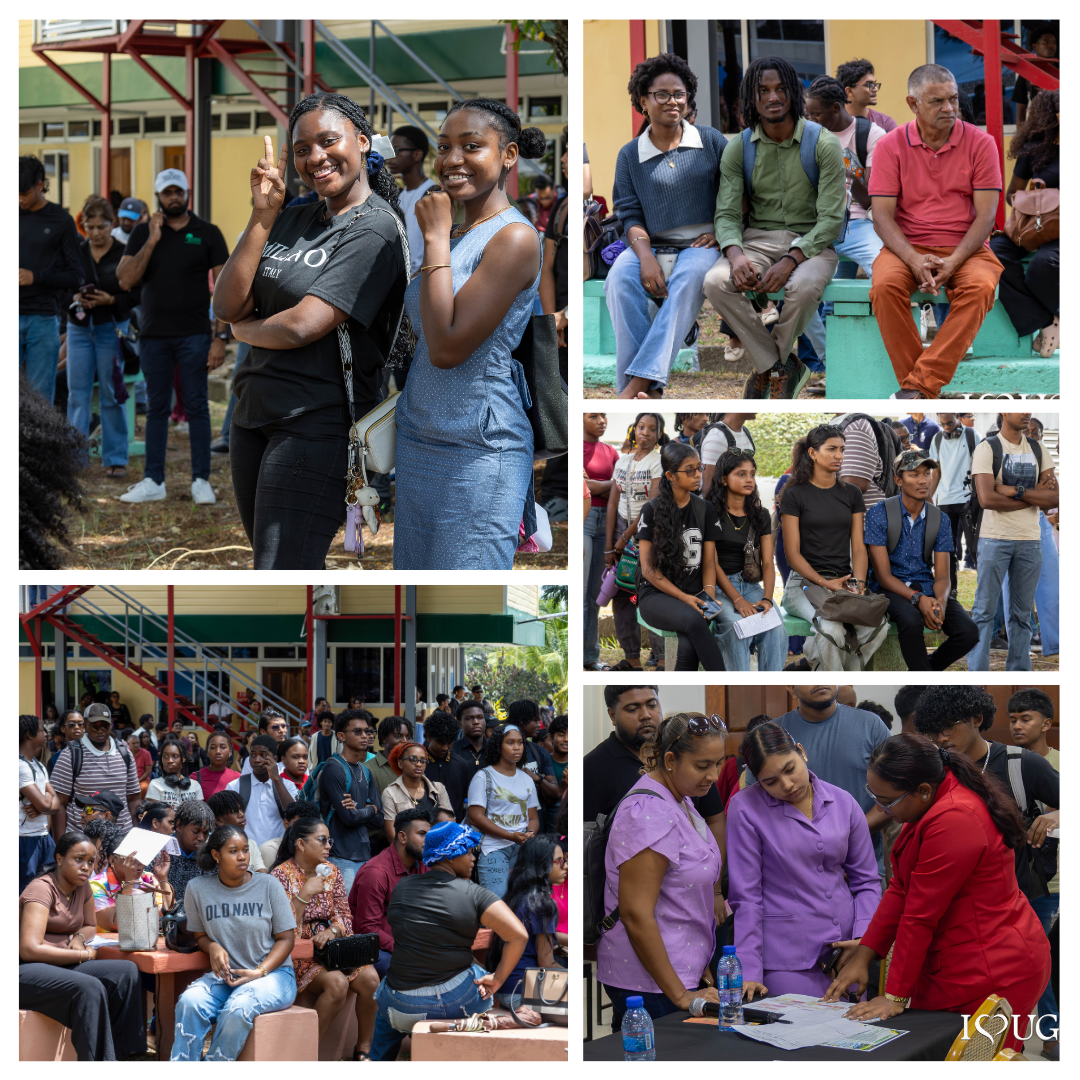
Students of the Faculty of Engineering and Technology (FET), and the College of Medical Sciences (CoMS) participate in orientation activities at the University of Guyana for the 2026/2027 academic year.
For generations, the road to a career in engineering or healthcare in Guyana began with a move to Georgetown. For close to 300 students this academic year, it no longer does.
[]Through the University of Guyana’s regional engineering and pre-medical programmes, students across the country are saving time and money and staying close to their families while they pursue university qualifications. The Faculty of Engineering and Technology (FET) now teaches 91 students in Region Two (Pomeroon-Supenaam) and Region Six (East Berbice-Corentyne), while the College of Medical Sciences (CoMS) Pre-Medical Sciences Programme serves more than 200 students from all ten administrative regions.
Both programmes are part of the University’s drive to extend tertiary education beyond the capital, and students say the difference is already clear.
For Jemima Mosley, a Pre-Medical Sciences student in Berbice, studying in her own region has made the transition to university life easier. “I’m much more comfortable and I can maneuver better with the classes,” she said.
Although her first weeks have been busy, Ms Mosley encourages others interested in medicine to apply. “It’s a great initiative that they did and I would encourage others that want to pursue medicine to join because it’s a really great start, a really great push,” she said.
[]Lower costs are only part of the change. By taking engineering and pre-medical studies to the regions, the University is weakening the link between where a student lives and whether that student can begin a professional career. Young people no longer have to leave their communities simply to take the first step towards engineering or healthcare.
[]Dr Kofi Dalrymple, Presidential Advisor, Tertiary Education, and Dean of FET, described the engineering initiative as a step towards a more inclusive and geographically accessible system of engineering education. “Our vision is to make engineering education accessible to talented Guyanese students, regardless of where they live. For too long, geography and the cost of relocation have been significant barriers to pursuing higher education,” Dr Dalrymple said. “By bringing our engineering programmes to Regions Two and Six, we are not simply making education more convenient; we are creating opportunities, developing talent within our communities, and helping to build the engineering workforce that Guyana needs for its continued development. We believe that a student’s potential should be determined by their ability and ambition, not by their geographic location.”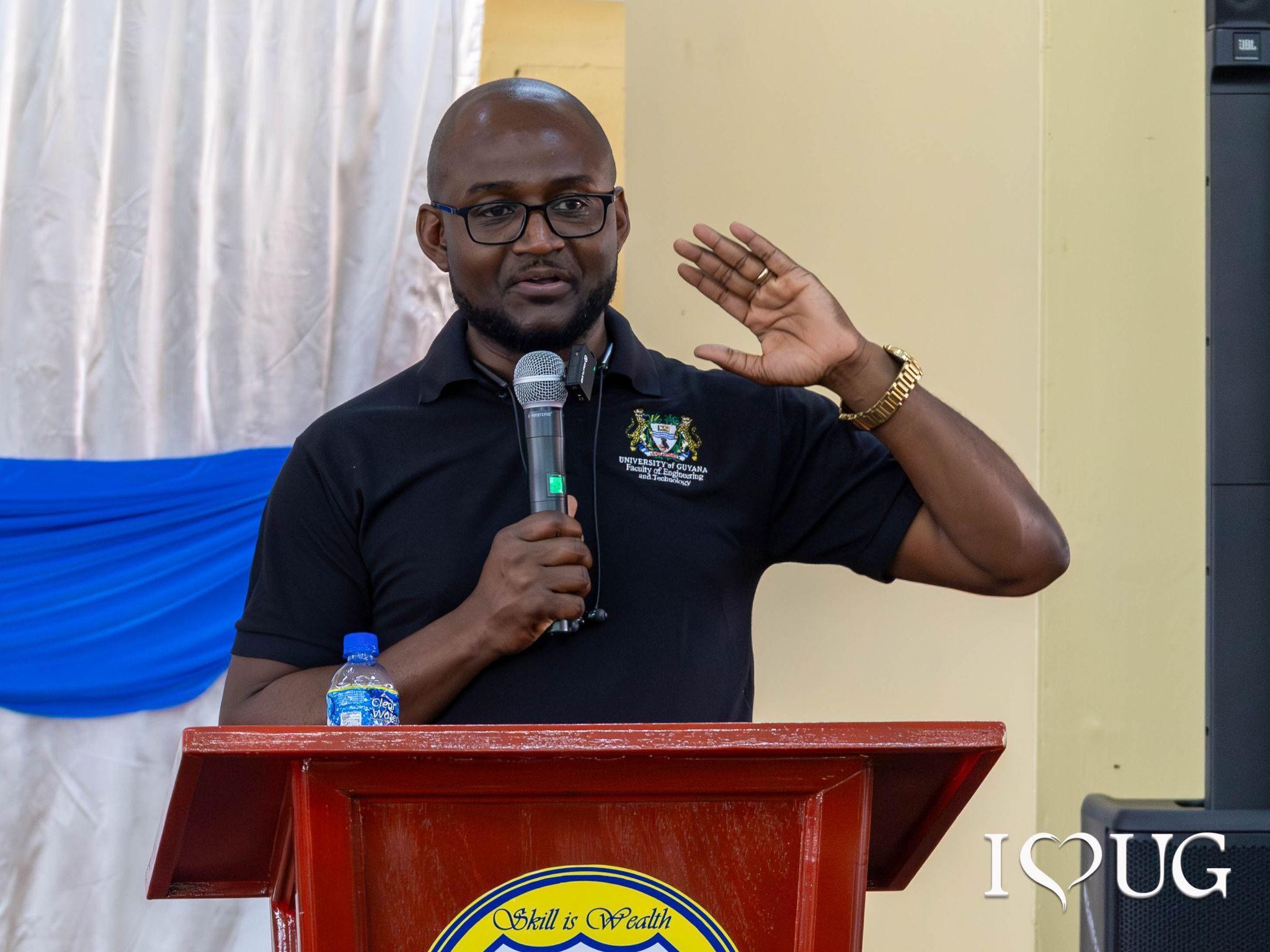
Dr Kofi Dalrymple, Presidential Advisor, Tertiary Education, and Dean of the Faculty of Engineering and Technology (FET) addresses students at the Faculty’s 2026 orientation in Essequibo.
The regional engineering programmes began in February 2026 on the directive of President Dr Irfaan Ali, a milestone in the University’s efforts to decentralise tertiary education. Civil and Mechanical Engineering are offered at the University of Guyana Berbice Campus, and Civil Engineering at the Essequibo Technical Institute in Anna Regina.
Of the 91 engineering students, 71 are at the Berbice Campus and 20 are in Essequibo. At Berbice, 54 students are enrolled in Civil Engineering (36 in first year and 18 in second year) and 17 in Mechanical Engineering (14 in first year and three in second year). In Essequibo, all 20 students are in Civil Engineering: 14 in first year and six in second year.[] The second-year students are the original cohort, who began in February 2026. A new first-year intake joined them this semester.
[]Interest has been strong. At the Berbice Campus, 111 prospective students submitted 135 applications, 89 for Civil Engineering and 46 for Mechanical Engineering, with some applying to both. In Essequibo, the Civil Engineering programme at the Essequibo Technical Institute enrolled 20 students across its first two intakes. Enrolment figures reflect the applicants who met the admission requirements and accepted a place.
Students can complete their engineering qualifications in their home region without transferring to the Turkeyen Campus, and the regional programmes meet the same academic standards as those delivered at Turkeyen.
For second-year Civil Engineering student Arianah Leacock benefiting from the programme in Region Six, the biggest difference is time. “It’s very convenient being able to do it at home,” she said.
[]Without the long trips to Georgetown, she explained, students have more time for their studies and for life outside the classroom: “They now have more time to do extracurricular activities because they don’t spend the majority of their time travelling, going to town, just attending classes,” she said.
[]Many of her classmates, she added, now have time to keep up with assignments. She was also positive about the teaching: “They delivered the content very well. We had no issue with that.”
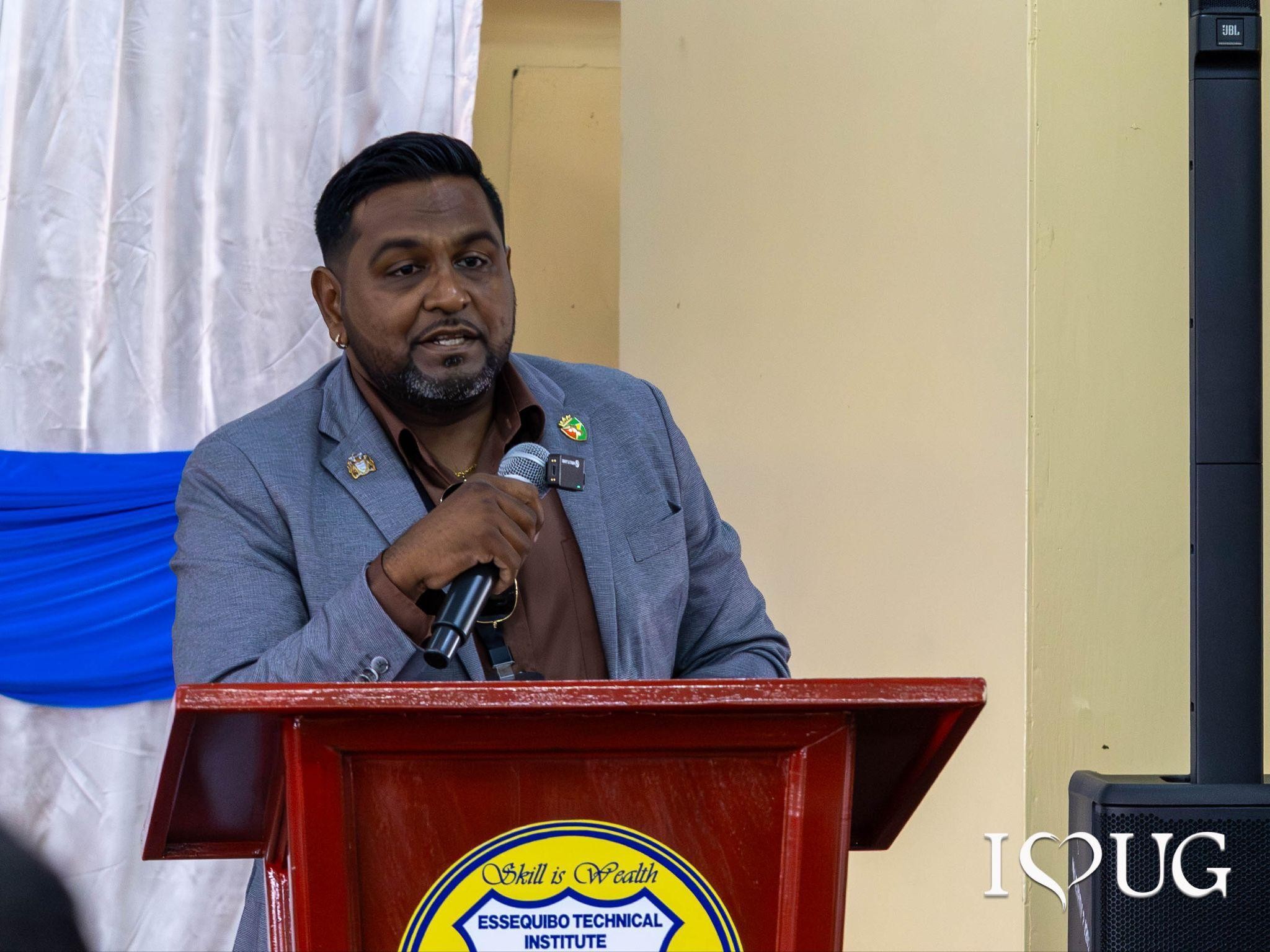
Dr Sean Sarran, Head of the Department of Civil Engineering, addresses students at the Faculty’s 2026 orientation in Essequibo.
Dr Sean Sarran, Head of the Department of Civil Engineering, said students value the arrangement. “Students appreciate being able to pursue engineering studies within or closer to their home regions, rather than having to relocate or travel regularly to Region 4,” he said.
[]He said studying in the regions can significantly reduce transportation, accommodation and living costs, and allows students to stay close to their families, jobs and other responsibilities. For some students, those savings decide whether university is possible at all.
For aspiring health professionals, the CoMS Pre-Medical Sciences Programme began its regional rollout in April 2026 and now serves more than 200 students from all ten administrative regions. It allows students outside Georgetown to begin pre-medical studies without relocating.
[]Demand is rising. The second intake, in September 2026, drew more applicants and more enrolments than the first intake in April. At the programme’s recent hybrid orientation, students joined from across the country and were welcomed as members of one university, one college and one national academic community.
[]The ten-region rollout is led by Professor Rajini Kurup, Dean of CoMS, and Dr Andrew Hutson, Assistant Dean.
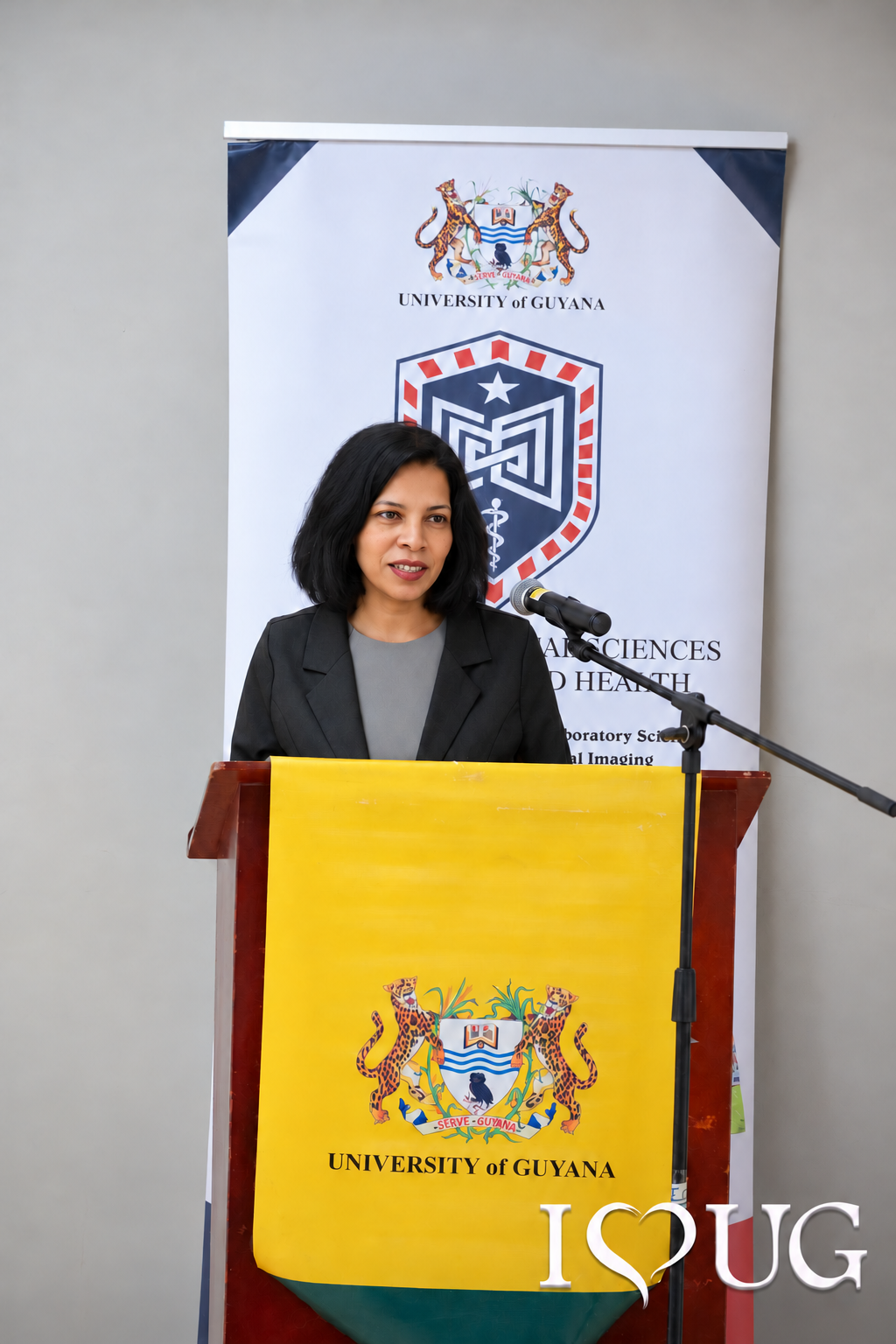
Professor Rajini Kurup, Dean of the College of Medical Sciences, who leads the regional rollout of the Pre-Medical Sciences Programme.
Professor Kurup has provided the academic and administrative leadership for the rollout, coordinating standards, staffing, regional delivery and student support so that growth does not come at the expense of quality.
She and Dr Hutson are directly responsible for Regions Four and Six. Dr Hutson has also worked with regional officials and the Ministries of Education and Health to put arrangements in place, including [e.g. teaching venues, laboratory access], and to connect regional partners. She and Dr Hutson have direct oversight responsibilities for Regions 4 and 6, and Dr Hutson has worked with officials in the regions and the Ministries to secure practical arrangements and connect regional partners.
[]The programme prepares students for medicine and other health fields, including dentistry, pharmacy, medical laboratory science, medical imaging, nursing, rehabilitation sciences and public health.
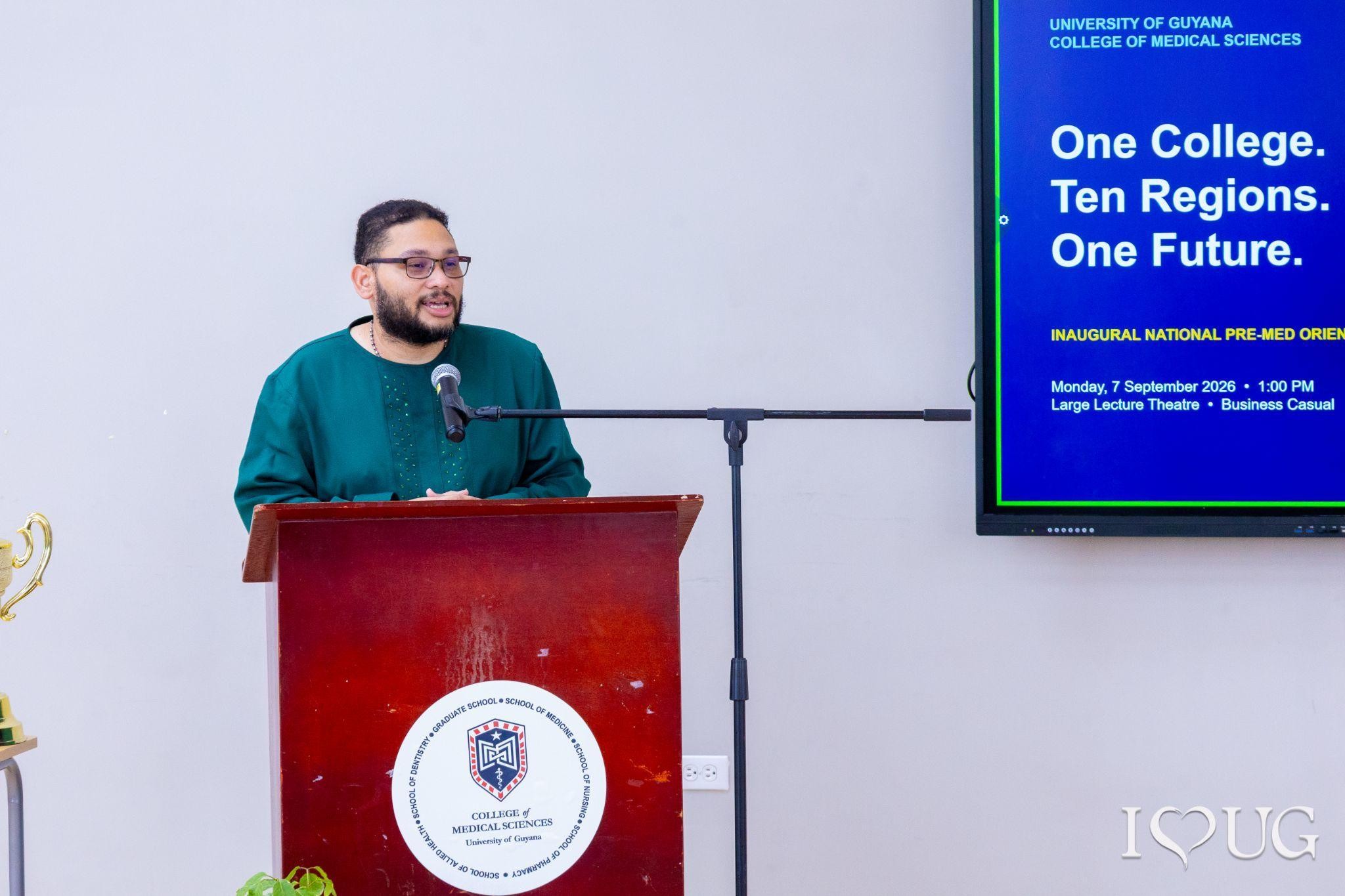
Dr Andrew Hutson, one of the persons responsible for overseeing the rollout of thePre-med programme across all ten regions, addresses incoming pre-medical students during the University of Guyana’s 2026 Pre-Medical Orientation.
Dr Hutson was clear that wider access does not mean lower entry requirements. “Pre-Medical Sciences expands opportunity; it does not remove standards,” he said.
Completing the programme does not guarantee admission to the Bachelor of Medicine and Bachelor of Surgery (MBBS), Bachelor of Dental Surgery (BDS) or any other competitive programme. Students must still meet the relevant academic and programme-specific admission requirements.
[]He added that decentralisation must be judged by what students can actually do: “Decentralisation is not achieved simply by announcing that a programme exists in ten regions; it is achieved when a student in those regions can actually access teaching, receive support, demonstrate competence and see a credible path forward.”
[]The University’s Maka Tawa Forest Campus at Aishalton, Region Nine (Upper Takutu-Upper Essequibo), shows what regional access can become: a permanent academic presence in the hinterland, from which programmes such as Pre-Medical Sciences can reach students without requiring them to leave their communities. “A student in the Rupununi should be able to look at the University of Guyana and see not a distant institution on the coast, but a national university that is prepared to meet the country where it is,” Dr Hutson said.
Both programmes respond to national needs. Guyana’s expanding healthcare, infrastructure, energy, construction and industrial sectors will require a growing pool of health professionals, engineers and technical specialists, and the regional programmes are designed to develop that talent in the communities where it already lives.
[]FET describes the engineering expansion as an investment in Guyana’s human capital that will build a more geographically distributed engineering workforce. The Pre-Medical Sciences Programme, meanwhile, is building a base of students prepared for careers across medicine and the wider health sector.
What comes next
Both faculties see the current rollout as a starting point. FET is exploring expansion into Region Three (Essequibo Islands-West Demerara) and Region Ten (Upper Demerara-Berbice), guided by student demand, available resources and its commitment to academic standards.
[]CoMS is developing a student-tracking system, with Region Four as its central information hub, to follow participation, academic activity and competency-based training across the regions. The College is also exploring how its other programmes could reach more communities without compromising the standards the health professions depend on. The aim, Dr Hutson said, is a national platform on which “geography should increasingly cease to determine whether a capable Guyanese student can begin exploring a future in the medical and health sciences.”
Although they serve different fields, both programmes share one purpose: removing the practical barriers that have kept capable students outside Georgetown from a university education.
[]The University thanks the many people who helped bring the regional programmes to life. For the engineering programmes, it thanks the lecturers and staff at the Berbice Campus and the Essequibo Technical Institute.
[]For the Pre-Medical Sciences Programme, much of the groundwork was laid under former Vice-Chancellor Professor Paloma Mohamed-Martin. Support also came from Dr Diana Gobin, Deputy Vice-Chancellor (Finance and Administration), and Deputy Vice-Chancellor (Academic Engagement).
[]The Faculty of Natural Sciences was pivotal in shaping the scientific foundation of the programme, particularly Professor Abdullah Ansari and Dr Patrick Ketwaru , Head of the Department of Chemistry. The University is also grateful to the Ministry of Education, including Hon. Sonia Parag, Minister of Education, and Mr Saddam Hussain, Chief Education Officer, and to the Ministry of Health, including Hon. Dr Frank Anthony, Minister of Health; Dr Cerdel McWatt, Acting Permanent Secretary; Dr Vishwa Mahadeo, Director-General; and Dr Narine Singh, Chief Medical Officer, along with officials of the Office of the President.
[]Regional coordinators have been central to turning policy into practical access: Dr Udo Amadi (Region One), Dr Ranjeev Singh (Region Two), Dr Fiaaz Hassan (Region Three), Dr Theresa Sarju (Region Five), Dr Nacasy Benjamin (Region Seven), Dr Monique Sarius (Regions Eight and Nine) and Dr Trevlon Braithwaite (Region Ten), together with the teams supporting Regions Four and Six.